Showing posts with label Theory Thursday. Show all posts

Theory Thursday #5 - Rust

by Massive Voodoo


Welcome everyone to the fifth Theory Thursday!

If you are not interested in understanding how the world works, especially light and shadow, color and harmony, you should better skip reading this post and future Theory Thursday editions.
Opposed to the very direct and practical tutorials you will usually find here, these series of posts will go in depth to answer questions that many painters didn't even ask themselfes.

Be reminded that these posts are written by Raffa alone and reflect his understanding of the topics.
He is not always right and if you found an error or you want to discuss, use the comment section!


This week the topic will be:
Rust

This weeks topic will be slightly different than the weeks before.
Light, lightwaves and electromagnetic radiation will have a week off for something more "real" and quite interesting.

Rust, everyone knows it. It looks cool as inspiration and it's annoying when it's on places where it shouldn't be.
Photo by Raffa taken in Spain

Rust is basically a mix of Iron Oxide and Iron Oxide-Hydroxide.

Iron Oxide (Fe2O3) is a very common chemical as iron reacts very happily with oxygen.
It's very hard to find pure iron in nature.
Iron Oxide has a typical red color that is and was used as a pigment very often to make colors.
By the way, many people know the typical red houses in countries like sweden, norway, etc.

Photo by Raffa taken in Norway

This color is called Falu Red and originated from a copper mine in sweden, it has more ingredients, but iron oxide is a very important one in giving it the typical color.

Most of the time, rust is not just red, that's because the Iron Oxide is hydrated.
Iron oxide-hydroxide Fe2O3·1 H2O) has a yellow color (also used as a color pigment).
It can be heated (to remove/vaporize the H2O) leaving Iron Oxide (Fe2O3) ...

But why is iron or alloys containing iron (like steel) rusting?
The process is called corrosion - it's an electrochemical process.


To make this possible you need an anode (a piece of metal that give electrons away), a electrolyte (a liquid that helps electrons to move) and a cathode (a piece of metal that accepts electrons).
Does this sound familiar to you?
Maybe now? Ok, doesn't matter anyway :)


In the case of iron corrosion, we need three components.
Iron, water and oxygen.

When water (our electrolyte) hits the iron a lot of stuff starts to happen.
First, the water reacts with the air to for different kinds of acids, especially with carbon dioxide.
This acid is an even better electrolyte than water and will speed up the process of corrosion as it will dissolve the iron.
The water will start to split up into it's core components (H2O = two hydrogen atoms and one oxygen atom) and the oxygen will start to bond with the dissolved iron into .... iron oxide!
Electrons are freed and will go to the cathode which can be another piece of metal less electrically reactive than iron or another part of the iron itself.

The more salt is present in the water (seawater, sweat, acid rain) the faster the rusting / corrosion will happen as it will be a better electrolyte.

The result is always the same, rust in reddish or yellowish hues.

Keep your eyes open and you will see rust on a lot of places, it's very nice to observe how rust works and where iron parts will rust.

You do now know why iron corrodes, so try to look out for places where water collects.
You will see that those places will rust much more.
 Photo by Raffa taken in Spain

And by the way, did you ever try to make your own rust / iron oxide pigments for painting rust?
Try out our tutorial, maybe with the knowledge from this article, you can even improve the process?

I hope you enjoyed this episode of Theory Thursday and read you next week!

Here are some more practical exercises:

An overview about Weathering, including theory and practical use.
 
Raffa explains different weathering techniques in a series of 4 videos.

How to: Rust Effects by ModelMates
This article explains how to apply rust.

Theory Thursday #4 - Rays and Reflection

by Massive Voodoo


Welcome everyone to the fourth Theory Thursday!

If you are not interested in understanding how the world works, especially light and shadow, color and harmony, you should better skip reading this post and future Theory Thursday editions.
Opposed to the very direct and practical tutorials you will usually find here, these series of posts will go in depth to answer questions that many painters didn't even ask themselfes.

Be reminded that these posts are written by Raffa alone and reflect his understanding of the topics.
He is not always right and if you found an error or you want to discuss, use the comment section!


This week the topic will be:
Rays and Reflection

In this weeks edition we will go a bit deeper in the way light works.
As I already wrote in the first edition of Theory Thursday, light is an electromagnetic wave.

Without going too much into depth how this works in a physical way we need to understand 'light sources' of all kind emit these waves.

If you imagine a flashlight, it's basically a electromagnetic wave shotgun (sounds friggin' awesome) sending out light rays in a forward direction. Or a lightbulb sending out light rays all around it.
Light rays travel straight forward (most of the time... a black hole can bend light rays, that's why it is black :-) at the speed of light ( ehrm... yes, thanks captn obvious!).
In a vacuum it doesn't lose energie and continues to travel until it hits any kind of matter.
That's why we can see stars in the night sky, even though they are so far away and the light takes years to travel from them to earth so we can see it.

So when a light ray basically travels until it hits something.

This something can be any kind of matter, even air influences light rays in a certain way.
If it hits solid matter or an angry silverback gorilla that hates light rays it comes to a stop.
The energy transported by this wave gets absorbed by the object (that's why the sun gives warmth)

But what if the object is not a gorilla or the light ray doesn't get completely absorbed?
The same that happens with every object that hits something and isn't destroyed.

It will be reflected!

A good example is a laser pointer and a mirror.
A mirror is not absorbing a lot of the light the laser pointer is producing, the laser point will be reflected back (don't look into the laser pointer if you try this out ;-)
The opposite is true for black, rough materials.
Black is absorbing a lot of the visible spectrum and so almost nothing is reflected back (that's why we perceive black as black... it's basically just very little light getting into our eyes)

That's why black cars are much hotter inside in summer than white cars. They absorb a lot of energy and act like an energy sponge. In this case the energy will be converted to heat.

So, why then are some materials so different, even when they have the same color?
Maybe you already read the word. Roughness.

How a light ray is reflected also depends on the surface of the object.
When a light ray hits a surface it is reflected back in the same angle of incidence.
Watch out, this 'simple' way of explaining it basically only works for solid, non conductive materials (not metals and not transparent or transluscent).
We will go more into detail on this topic in a later isse of Theory Thursday ;)

Ok, so if the surface is perfectly smooth, the ray will be reflected back in the same angle it hit the surface (measured perpendicular to the surface).

Look at the above illustration and you will quickly understand what is the difference between smooth and rough materials. Rough materials scatter the light and create a much softer reflection.
 
Here you can see two spheres, one is more a wool like material, the other one is polished.
A sharp reflection creates a shark highlight.

Hopefully this article explained the basics about reflected light rays.
What can you do with this knowledge?
Understanding materials and try to paint them on miniatures :)
Effects like non metallic metal are waiting for you ;)

I think at this point I will stop with this weeks Theory Thursday and go on with reflections and bouncing light rays next week!

_______________________________________________________________________________
You want to support Massive Voodoo? 
If you like to support or say thanks the monkeys of Massive Voodoo in what they do, please feel invited to drop a jungle donation in their direction via paypal or check their miniatures they got on sale here.
_______________________________________________________________________________

Theory Thursday #3 - All cats are grey at night

by Massive Voodoo


Welcome everyone to the third Theory Thursday!

If you are not interested in understanding how the world works, especially light and shadow, color and harmony, you should better skip reading this post and future Theory Thursday editions.
Opposed to the very direct and practical tutorials you will usually find here, these series of posts will go in depth to answer questions that many painters didn't even ask themselfes.

Be reminded that these posts are written by Raffa alone and reflect his understanding of the topics.
He is not always right and if you found an error or you want to discuss, use the comment section!


This week the topic will be:
All cats are grey at night

Have you heard this saying? I am pretty sure most people have.
But how much truth is in this sentence?

Let's start with a photo taken at daytime.
It's a photo taken at the Miniatur Wunderland, such a crazy place :D

We cann all agree that night- and daytime look different by a huge degree. But why?
Let's first analyse the one thing we know for sure: it's darker!
At night there is less light than at daytime (we're not talking about places with artificial light like lightbulbs, fluorescent light or similar, just the moon)

So if we take the photo from above and make it a bit darker, we should have a night scene.

Hmmm, this doesn't look like a night scene at all, more like the look through sunglasses.


Let's try to understand how the eye works at night to get a better idea why "all cats are grey at night".

The eye is a really complex piece of evolutionary excellence. We can see at night and day.
Compare this to a camera and you will quickly notice how awesome an eye is and how much range we are able to see.

We talked about color cones in the first edition of Theory Thursday.
Color cones enable us to see colors and brightness levels.
But they have one limitation, they need a lot of light to work, so they only work at daytime.

In low-light situations, their brothers, the famous rods are used to see.
Rods, like cones, are located in the back-inside of your eye.
They are much more sensitive to light, so they are useless at day (too much light).
Also, they need much longer to adapt to new light situations.
While cones can adapt to a maximum degree in several minutes, rods need more around 30-45 minutes to fully adapt to a low light situation.

And, the most important difference to the cones for our question:
Rods are all the same - to see color we have three different kind of cones (Red, Blue and Green).
Rods are all the same, they do not detect wavelength of photons but the amount of photons incoming.
So they produce a monochromatic image. Basically a Black and White image.

So, we already answered the question!
That's the reason all cats are grey at night.


But... isn't this a bit boring? Yes!
Let's dive a bit deeper into night vision!

Rods are not detecting different wavelengths of light, but they have a sensitivity towards a certain wavelength - blue (~500 nm) and they are almost blind to others - reds (~620 nm).


If we look at the visible light spectrum,...

image from Wikipedia by Deborah S Krolls 

We will notice that the sensitive area of the rods is pretty much on one side of the visible spectrum.
While rods are sensitive to blues and greens, reds and yellows are much less strongly perceived by them.

You can easily see the effect on a red rose. 
Look at it at daytime and the red will look much brighter than the dark green stem.
If you look at it at night (without artificial light), the stem will look brigther than the red rose.

So, not only will everything be grey at night, colors will shift in the appearing brightness compared to daytime. 
This is very important when painting night scenes or trying to understand the theory behind it.

Did you ever notice that the military uses red light at night? 
(sometimes, other colors [blue light to see blood] are used for different situations, just to state this before we get a shitstorm in the comments :D )

It's a trick to keep the rods adapted to the dark light while beeing able to see better at night.
Rods are basically blind to red light, so the cones are used to see it. Because the cones are used, the rods stay adapted to night vision.

Let's have a look at the first photo again
At night, it would look more like this:
Pay special attention to the reds and yellows, blues and greens!


To finish this article my conclusion is:
All cats are grey at night, but orange cats are darker.

Hopefully you enjoyed this third edition of Theory Thursday and read you next week :)

Always remember, painting is not algebra or physics.
Theory Thursday is about fun facts and interesting things around us.

_______________________________________________________________________________
You want to support Massive Voodoo? 
If you like to support or say thanks the monkeys of Massive Voodoo in what they do, please feel invited to drop a jungle donation in their direction via paypal or check their miniatures they got on sale here.
_______________________________________________________________________________

Theory Thursday #2 - Complementary Colors

by Massive Voodoo


Welcome everyone to the second Theory Thursday!

If you are not interested in understanding how the world works, especially light and shadow, color and harmony, you should better skip reading this post and future Theory Thursday editions.
Opposed to the very direct and practical tutorials you will usually find here, these series of posts will go in depth to answer questions that many painters didn't even ask themselfes.

Be reminded that these posts are written by Raffa alone and reflect his understanding of the topics.
He is not always right and if you found an error or you want to discuss, use the comment section!


This week the topic will be:
The Complementary Color Conspiracy

Ok, now this sounds a bit over the top, doesn't it?

First, let us talk about complementary colors.
Complementary colors do exactly what the name says, the complement each other.
They are opposed on the color wheel and mixed, they complement each other to a neutral grey (in theory)


Looking for complementary colors is easy, just take a color wheel and find two opposing colors!

Sounds simple, but there are many, many different color wheels and color systems.
In the first Theory Thursday we already talked about the topic of subtractive and additive color mixing.

And maybe you do know these complementary colors:
They are a bit different from the ones I was showing in the previous image.
And many would agree that red & green, blue & orange and yellow & violet.
These different pairs of complementary colors are born from different color wheels and perceptions.

Ok, we could already finish this edition of Theory Thursday here and agree:
There are many different ways of seeing complementary colors.....


Ha! That would be easy!
But as I wrote in the introduction, this is my way of understanding colors so I will try to share my point of view on this topic.


Let's go back to last weeks edition and remember the color cones!


It's a proven, researched fact how our eyes and brains work together, so it would be best to approach this problem in a way that relies on facts :)

How do we actually SEE complementary colors? And why are they so strong?

Many people know about the way that color cones work or at least that we got them in our eye.
We have Red, Green and Blue color cones collecting information and transfering them to the brain.

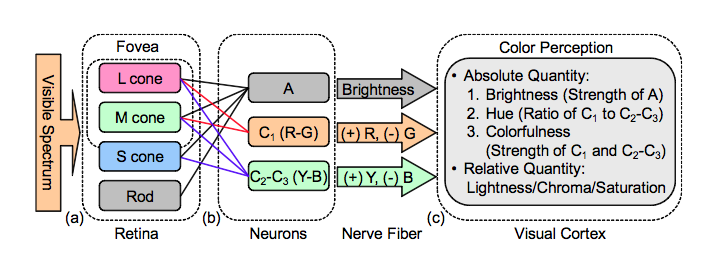
But here we have a problem... the brain does not get the information of the color cones in a direct way. It can't process all the information of all three types of cones so the evolution gave us a pretty smart way of pre-processing the signals of the color cones.

This pre-processor or filter get's information by different combination of cone responses and creates a signal that is then sent to the brain.

To create a full image of what we actually see in our brain, we need three types of information:
RED / GREEN
YELLOW / BLUE

BRIGHT / DARK

these three information can be generated with different filters that combine the color cones information into electric signals that are sent through the nerve fiber to the brain.

It's a bit complicated to explain the whole process..
image from Wikipedia by Googolplexbyte

Maybe this image explains it a bit better (even when the most detailed explanation is missing).

Phew.... now it would be a good time to say:
"Raffa, why in the name of sweet baby banana monkey are you telling us all this strange stuff?"

Why are we even thinking about the right complementary colors when our body is using the strongest contrasts to see the world?

Red and Green, Blue and Yellow are the complementary contrasts that are the strongest to see for the eye. Are those the ones you like the most? I don't know!

So, still, after explaining a little bit about complementary contrasts, I can still not tell you which one to use.

I personally love blue and orange. 

Tell us about your favourite in the comment section!

_______________________________________________________________________________
You want to support Massive Voodoo? 
If you like to support or say thanks the monkeys of Massive Voodoo in what they do, please feel invited to drop a jungle donation in their direction via paypal or check their miniatures they got on sale here.
_______________________________________________________________________________

Theory Thursday #1 - The full Color Wheel

by Massive Voodoo


Welcome everyone to the first Theory Thursday!

If you are not interested in understanding how the world works, especially light and shadow, color and harmony, you should better skip reading this post and future Theory Thursday editions.
Opposed to the very direct and practical tutorials you will usually find here, these series of posts will go in depth to answer questions that many painters didn't even ask themselfes.

Be reminded that these posts are written by Raffa alone and reflect his understanding of the topics.
He is not always right and if you found an error or you want to discuss, use the comment section!


We will start with very basic stuff and will advance more and more into the depth of physics.

This week the topic will be:
Why is the color wheel a full circle?

This sound strange at first as most of us are used some kind of color wheel.
The color wheel is our friend, how can anything be wrong with him?
And why shouldn't the color wheel be full circle as it makes perfect sense the way it is?


Let's start simple at the very beginning of everything, the birth of color.
Color is perceived by a interaction of electromagnetic waves and our eye.
Don't stop reading now even if it sounds complicated at first.

There are a lot of different spectrums of electromagnetic waves, to name a few well known, x-rays, infrared, ultraviolet, radio and tv, microwaves and the one we will be talking about now (and I guess the most important for a painter), the visible spectrum.

Electromagnetic waves are made up of photons. Depending on the power the photon has, it has a different wavelength. This wavelength is responsible for the spectrum in which this photon will be.
A powerful photon will have a short wavelength and can even be harmful (gamma rays - radioactivity). But let's move away from photons as this may be interesting, but it's a really deep topic and won't bring us any closer to answering the question of the color wheel! We will talk about photons and electromagnetic waves in a later edition of Theory Thursday.

The visible spectrum is the area of electromagnetic waves that are visible to us.
It begins directly after ultraviolet with violet/blue and ends with red before infrared.

Did you ever see a rainbow? I hope so, otherwise your life would be very sad and you should start searching for a rainbow immediately! Rainbows are a joy to look at and you can hear people go "ahhhhh" and "ohhhh" when they see one. Especially true for double rainbows - with all those colors.
Some people even say there is gold at the end of a rainbow but I tried to find it once and there was only unicorn poo.
However a rainbow is a good example of the visible spectrum of light.
image from Wikipedia by Takkk

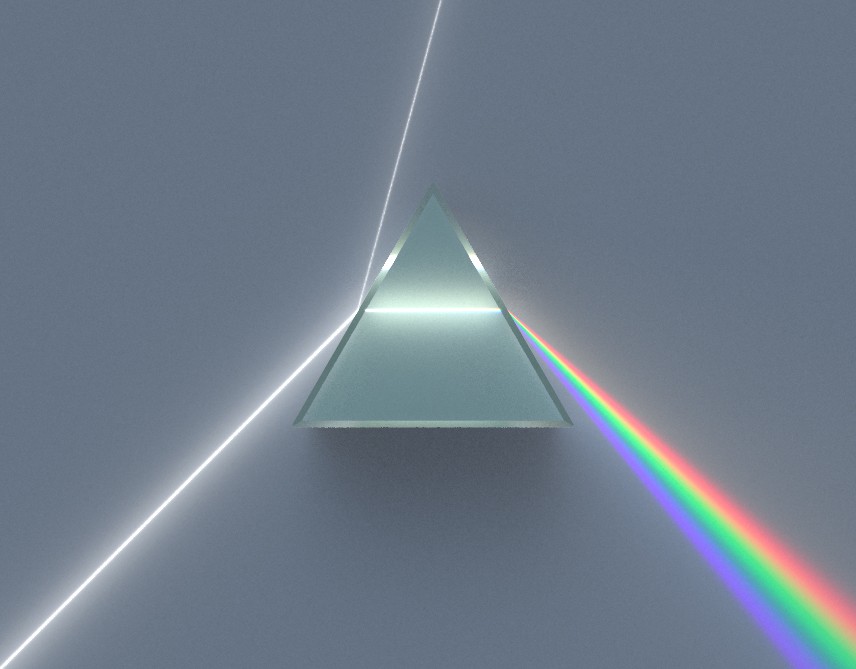
Same for a prism, maybe you saw one in physics class in school. Probably it was very boring back then. A prism splits up light into single wavelengths of visible light.
image from Wikipedia by Spigget

We see the visible spectrum which is this
image from Wikipedia by Deborah S Krolls

Maybe you already noticed something by now.
If not take this color and try to find it on the visible spectrum.
MAGENTA! Magenta, the connection between Red and Violet. Closing the Color Wheel and making it a full circle. Without Magenta it wouldn't be a full circle.
But how can it be?
How can we see a color that doesn't exist as a photon?

Magenta isn't a physical color, it's a physiological color.
We can see Magenta because of our brains are awesome and found a solution for a problem.

To understand how we can see Magenta and why we see Magenta we have to understand how the eye and brain works.

Let's skip this whole boring lens-inverting-image-focus-image bla bla stuff and let's focus on color.
You can see different colors because of little cones inside your eye. (They also make you able to see the brightness levels AT DAY. There are also rods, those help you to see in the dark and see motion and peripheral vision, we will also talk about rods in the future and the influence of them on colors at night).

Those cones are split up into three different kinds, Red, Blue and Green resembling the primary colors. 

Red is a very strong cone, he has many brothers that make up the majority of cones in the eye.
Blue is always sad, he has only very few brothers (2% of the eyes cones are blue) and beeing blue all the time is - not - cool!


Maybe some of you already yell at the monitor...
"You LIAR, those are NOT the primary colors!!! It's Red, Blue and YELLOW!"

So let's do a short excursion into the world of primary colors.
Well, the primary colors depend on the medium and the way they mix.
Let's start with the primary colors we all (hopefully) know.
The primary colors for painting, printing etc.
The subtractive mixed colors.
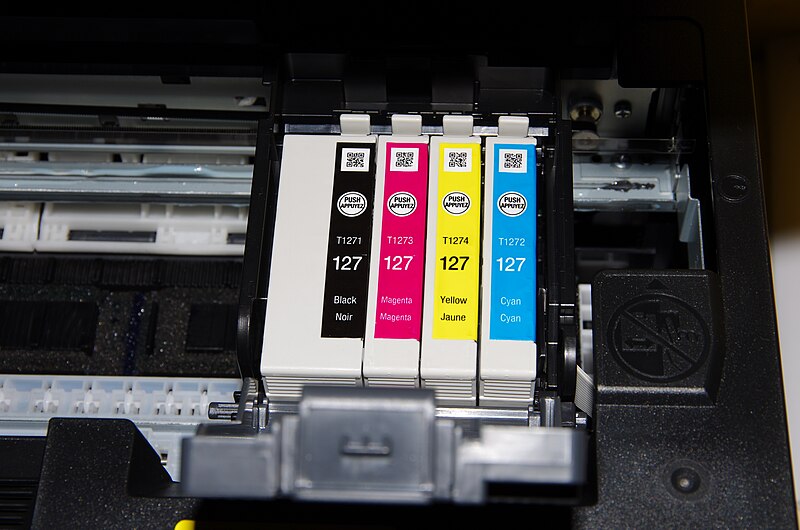
Red, Blue and Yellow... well almost! Did you ever look inside your printer?
 image from Wikipedia by DragonLord
Those are the 'real' primaries for mixing subtractive colors.
Magenta, Cyan and Yellow (Black is basically just a money saver...).
Legends say you can mix any color using these three primary colors.
And it's actually not that far from reality.


You can mix basically all colors with these three primary colors.


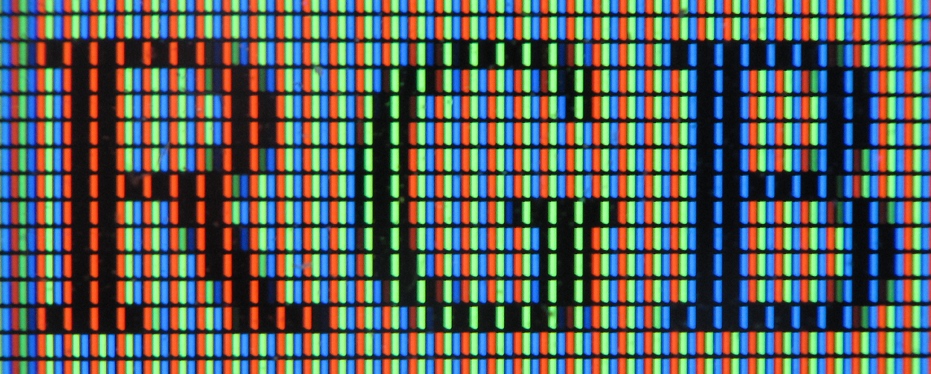
Now, opposing to this, lightwaves are mixed additively, the primary colors are Red, Blue and Green.

If you don't believe me, go closer to your monitor and you will see small primary colored lights.
image from Wikimedia Commons by Luís Flávio Loureiro dos Santos
Click on this image to zoom in and see how individual pixels create all the colors on your monitor.

And how does our Brain interpret what colors we see?
Imagine the three color cones beeing hit by light in a certain wavelength.
For example pure red.
The red color cone will completely explode from excitement while blue and green are completely bored by the color and not stimulated at all. RED! RED ALL THE WAY!!!

Now let's hit the cones with some yellow.
Yeah! Exactly how you already guessed, Green and Red are having a great time, both are equally excited and blue is still sad and lonely.

If you look at the additive mixing circle, you will notice that if you mix all three primaries, we will get white.

Yay, BFF!

Objects in the real world absorb certain wavelengths and the rest, the spectrum that isn't absorbed will be the "color" of the object. So a banana basically absorbs all colors except yellows, an apple absorbs all colors except red and so on. This determines the color of an object.
If an object reflects the whole spectrum, the color we will see is white.
Because all of our color cones are stimulated our brain interprets that it must be white.
white light containts all colors of the visible spectrum.
Oh, and black means, no light is reflected/received at all.

Ok, let's stop with all these super-obvious examples and let's find out about friggin Magenta!

If you look at the additive mixing table, Magenta is a mix of blue and red, so when both wavelengths hit the cones at the same time, the brain has to know: is it something BETWEEN Red and Blue on the visible spectrum which would be Green, OR is is just Red and Blue without anything in between.

An Example:

If the Red Cones and Blue Cones are stimulated about 70% AND Green Cones are stimulated 100%, the color must be some bright green.
Now let's remove the Green Part of the color and guess what happens.
Red and Blue Cones are stimulated, but the brain notices a lack of Green stimulation, so it CAN'T be Green.
A Magenta!

Normally the middle between blue and red on the spectrum would be green. But that's (one reason) why we have three kind of cones and not just blue and red. To tell if it is actually green or not.

The Brain makes a new color to tell us if it is Green or not, you could basically call Magenta the "Anti-Green".
 Or is Green 'Anti-Magenta'?

It's basically a way of our Brain to seperate stuff that is purely red + blue from stuff that is kind of greenish. In our survival that was a big thing. Eating a 'Magenta' colored fruit could have a different effect than a bright greenish fruit. Vomiting, dying or beeing exiled by your group of friends for eating strange stuff could be the result.

And with this knowledge it leads to the answer of our question:
Why is the color wheel a full circle?

Because our Brain is awesome!

We really hope you enjoyed this kind of unusual post on Massive Voodoo and if you are thursty for more Theory Thursday (ok, this was a bad one) check Massive Voodoo again next week!

Next week we will have the following topic:
The Complementary Color Conspiracy

We will also have a further look on how the brain processes the informations collected by the color cones inside the eye. Just in case you think this topic was somehow skipped :)


_______________________________________________________________________________
You want to support Massive Voodoo? 
If you like to support or say thanks the monkeys of Massive Voodoo in what they do, please feel invited to drop a jungle donation in their direction via paypal or check their miniatures they got on sale here.
_______________________________________________________________________________